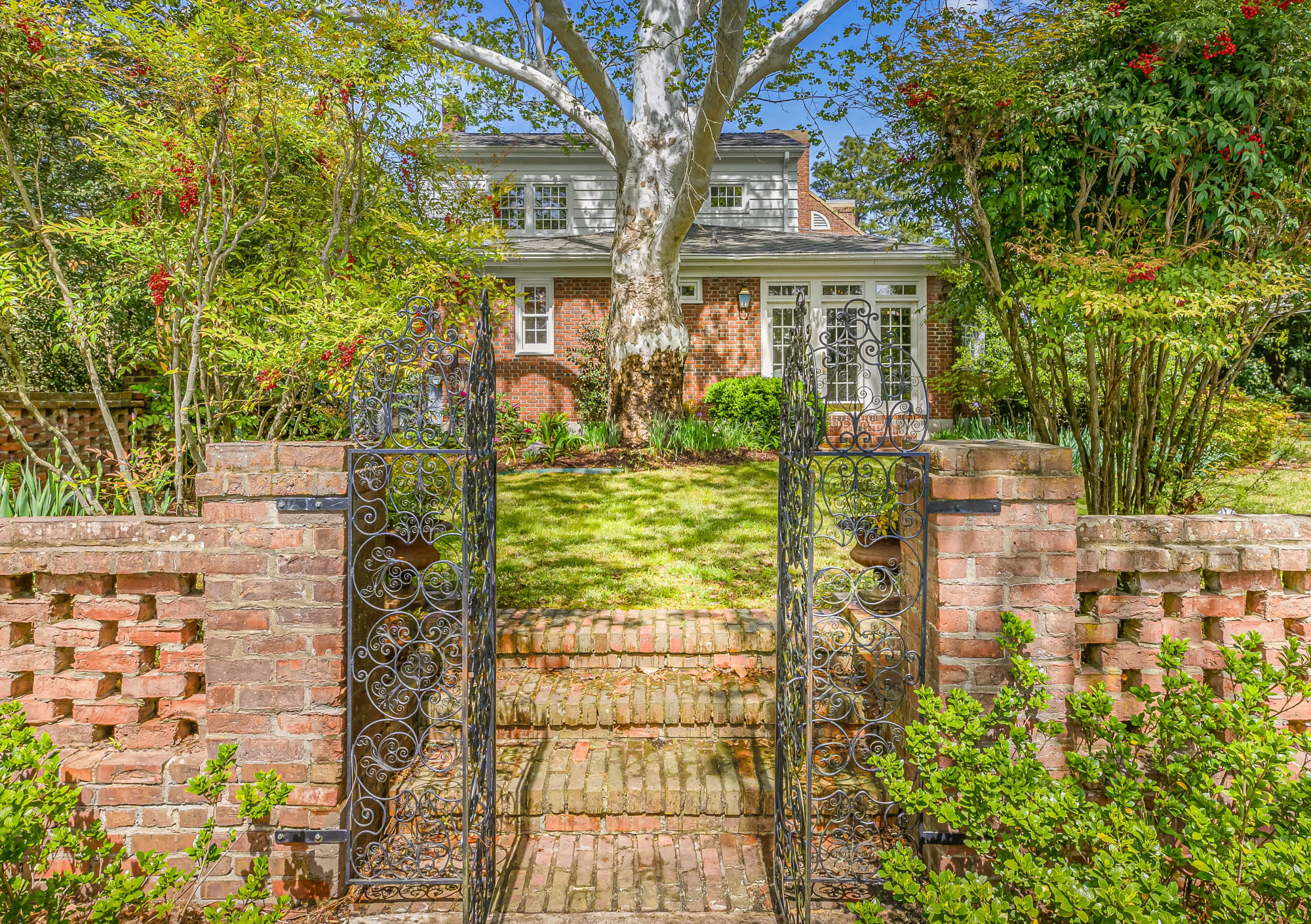
In 1916, those were saplings. Now they are a forest.
Neo-Georgian. Four columns. Original 1916 brick — three months were spent sourcing period-accurate replacements when restoration began. Seven fireplaces. 4.15 acres inside the Pinehurst ETJ. Six thousand and seventy-two square feet of living area. Twelve thousand six hundred eighty-one total.
Built by Leonard Tufts' own craftsmen — the same men who built Pinehurst.
The leaded glass sidelights and fanlight are original. The hardware was specified in 1916. It has not been replaced.
One detail makes everything clear: the inscription in the threshold — GARRAN HILL · 1916.
He named it before it existed. The house has been answering to that name ever since.
Original leaded glass sidelights and over-door fan. White raised-panel wainscoting to chair rail. Herringbone brick floor laid before a single wall was framed. The mahogany staircase volute turns the same curve it has turned since 1916. The hall axis carries straight through to the library at the back — visible the moment the door opens. Three staircases in this house. The proportions were drawn in 1916 and they have not been touched.
The hardware was specified in 1916.
It has not been replaced.
Born in Cary, North Carolina. Co-founder of Doubleday, Page & Co. Editor of The Atlantic Monthly. In 1913, Woodrow Wilson appointed him Ambassador to the Court of St. James — the most important diplomatic post in the world as Europe moved toward war.
From London, he wrote home constantly. Not about diplomacy. About the farm. When he wrote “the farm,” he meant Garran Hill — the hundred-acre tract he purchased in February 1913, named by him, already under construction three thousand miles away. The original estate ran to roughly a thousand acres of timbered land; today’s 4.15 acres is the house parcel.
His son Ralph supervised the construction. Leonard Tufts provided the craftsmen — the same men building Pinehurst. The house was completed in 1915–16.
He returned to America in December 1918. He was carried off the train at Aberdeen station. He died ten days later. He never spent a night at Garran Hill.
He named it. He never spent a night here.
The salon runs nearly forty feet. Tall bare windows parade down both sides. One end anchored by a fireplace. The room was enlarged to its current proportions — then left alone. Coffered ceiling. All seven carved mantels saved from the original structure, repaired and reset.
It is a room that expects people in it.
Georgian carved mantel. Delft tile surround — blue and white, hand-painted, original. The arch motif that runs through the entire house appears here in the cabinetry, in the doorways, in the fanlights above. It was specified in 1916. It is still there.
Original frontpiece. Shell cabinets — still there. Butler's arched niche. Seventeen feet by nineteen. The room holds its proportions. It has not been asked to be something else.
Built-in shelving on three walls. Floor to ceiling. Rolling ladder. French doors to the rear grounds. Brass chandelier. Designed in 2000 to the same standard as the 1916 house it joined.
When you stand in it, you cannot find the seam.
Reclaimed heart-pine floors — the only room in the house that departs from the original oak. Updated in 2000. Two farm sinks. The wall of windows faces an expanse of grass bordered by elder magnolias.
Every morning at 6:30, the deer come through.
Every component custom-designed. Fifteen architectural drawings document the decisions Thomas O'Shea made. They survive. They transfer with the property.
The balcony — 24 by 11 feet — faces the grounds. Three Jacuzzi tubs in the house. This is one of them.
Three staircases. A 24-by-11-foot balcony from the yellow bedroom and nursery. The arch motif — every door, every fanlight — runs unbroken through all four floors. Proportions matched to 1916 in the 2000 drawings.
An arched cabinet — the arch motif, again, consistent through every door and every room since 1916. The brass hardware, original. The wallpaper, fuchsia. The vanity, Tennessee marble.
Every room needs a moment. This is that moment.
Low-voltage landscape lighting along the entry drive. Underground utilities throughout. Twenty-eight irrigation zones fed by a 130-foot well. A 20-by-40-foot salt water pool, surrounded by a brick wall with iron gates. Restored in 2022.
The Wee Cottage — complete, self-contained — was moved to the grounds by sky crane.
Blue Fox · Betty Dumaine’s Irish Hunter · Buried on Grounds
Someone still puts flowers there.
Elizabeth Dumaine purchased the property in 1959. She was a foxhunter. She added stables, kennels, and an enclosure for peacocks. She renamed it Hollycrest. She hosted the Queen of Thailand — a college friend — and her entourage.
Her favorite horse is buried on the grounds.
Architect Thomas O'Shea led a complete interior restoration. General contractor: Dennis Dunagan. The interior was gutted. All plumbing and electrical replaced. Custom Marvin windows made to match the 1916 originals. A five-zone climate system engineered specifically to protect the original architecture above it.
All seven carved mantels saved. Most of the original oak flooring lifted, repaired, and relaid. The period-accurate portico brick took three months to source. They found matching ones. The house did not lose a single brick.
Fifteen architectural drawings survive. They transfer with the property.
The Pines Preservation Guild visited in April 2024. A preservation easement is available: North Carolina tax credit of 25% of fair market value, up to $500,000. Federal income tax deduction potential for the buyer.
The property qualifies under Criterion B — associated with individuals making significant contributions to history. Fifteen architectural drawings transfer with the property.