Garran Hill · 200 Hollycrest Drive · Pinehurst, North Carolina
The History
A documented provenance. Every claim on this page carries a citation, and the sources are listed in full at the end.
I · The Land
Pine barrens, a railroad, and two families
Before there was a house, there was timber. Allison Francis "Frank" Page, a lumberman and the founder of Aberdeen, North Carolina, logged the longleaf pine barrens of Moore County in the late nineteenth century.5 In 1895, James Walker Tufts purchased a stretch of that cut-over land and began building the resort village of Pinehurst on it.5
Frank Page's first son was Walter Hines Page. The land his father had logged, two miles southwest of the new village, is the land Walter would one day buy back for himself.5
II · The Man
Walter Hines Page and Garran Hill
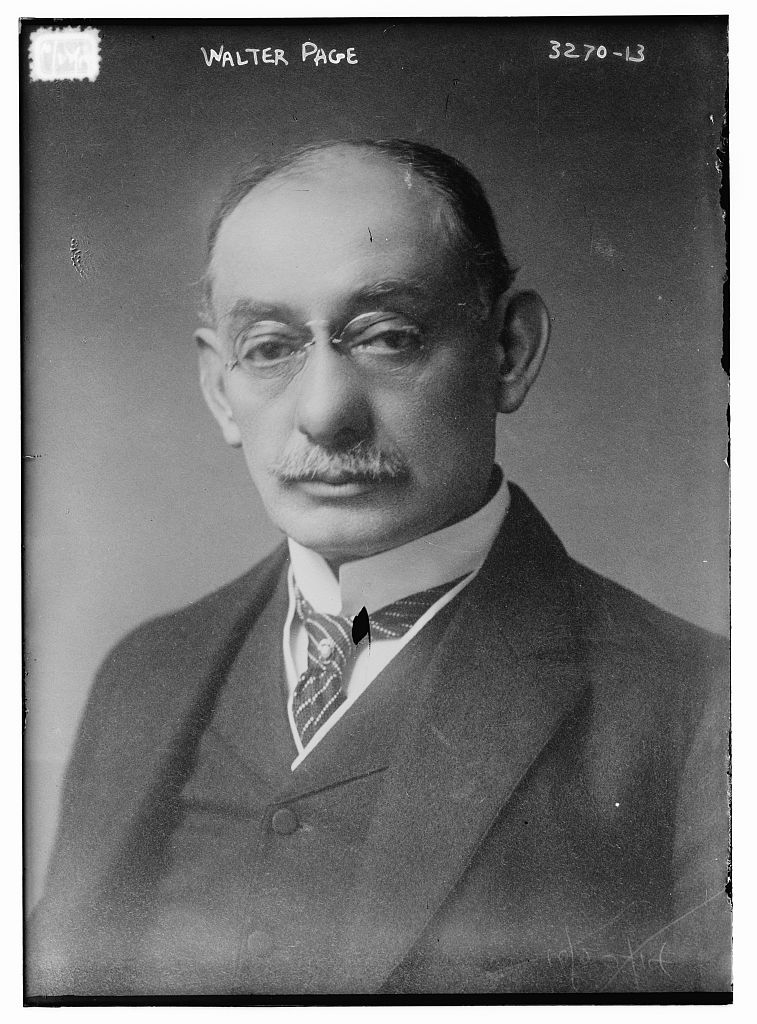
Walter Hines Page. Bain News Service, circa 1910s. Library of Congress, Prints & Photographs Division. No known restrictions on publication.11
Walter Hines Page was born on August 15, 1855, in the Wake County settlement that became Cary, North Carolina.5 He studied at Trinity College, at Randolph-Macon, and at Johns Hopkins, where in 1876 he was one of the twenty-one founding students of America's first graduate school.5
His career ran through the center of American letters. He founded the State Chronicle in Raleigh in 1883, edited The Forum and then The Atlantic Monthly, and in 1899 co-founded the publishing house Doubleday, Page & Company with Frank N. Doubleday, where he published Theodore Dreiser, Booker T. Washington, Rudyard Kipling, and Upton Sinclair.5 In 1900 he founded the magazine The World's Work and edited it until 1913.5
In February 1913, Page bought land in Moore County. The Pinehurst Outlook announced it at the time: "Dr. Walter Page, editor of 'World's Work,' has purchased a thousand acre farm . . . upon which he will build a winter home."1 He named the place Garran Hill and planned a peach orchard. What survives today, at 4.15 acres, is the original house parcel of that thousand-acre farm.
Six weeks later, Woodrow Wilson appointed him United States Ambassador to the Court of St. James's. He sailed for London on the Baltic on May 15, 1913, and held the post through the years the world came apart.5
III · The House
Built from London: the Pinehurst Company, J. R. McQueen, and a Boston plan
Page directed the creation of Garran Hill from three thousand miles away. His son Ralph W. Page supervised construction on the ground, working from plans drawn by a Boston architectural firm.6
The builders are a matter of newspaper record. In November 1916 the Pinehurst Outlook reported the Page house under construction by "Mr. Tufts' men under the supervision of Mr. J. R. McQueen."2 The National Historic Landmark nomination for Pinehurst corroborates it, describing the Pinehurst Company's crew of carpenters and masons under McQueen erecting the house for Walter Hines Page.8 By 1916, "Mr. Tufts" meant Leonard Tufts, son of the founder. The same organization that built the village built this house.
The house was finished in 1916: Neo-Georgian, in rare brick laid in Flemish bond above a water table, with the name set at the threshold. GARRAN HILL · 1916.
From the embassy, Page wrote home about it constantly. Not about diplomacy. About the farm.
"Build the farm, therefore; and let me hear at every stage of that happy game."
Walter Hines Page to Ralph W. Page, March 1918 · The Life and Letters of Walter H. Page, Vol. II4
His letters from 1918 lay out a complete country estate in words: asparagus and sweet corn, figs and pecans, scuppernongs and strawberries, and above all the peach orchard.4 "The farm — the farm — the farm," he wrote. It appears in letter after letter.4 By April 1919 the orchard was real: the Outlook reported the Garran Hill rail siding preparing to ship fifteen thousand crates of Elberta and Georgia Belle peaches, with fifty thousand trees in bloom.3
IV · The Return
December 1918
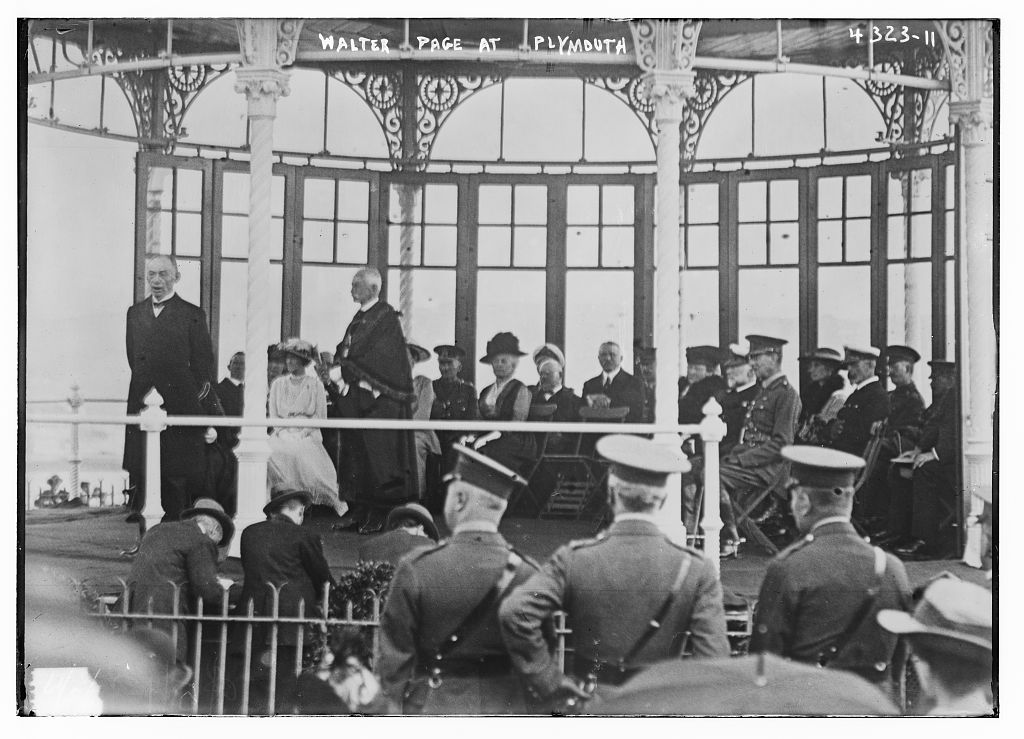
Ambassador Page at Plymouth, England, 1917. Bain News Service. Library of Congress, Prints & Photographs Division. No known restrictions on publication.11
The war broke his health. Page resigned the embassy in August 1918 and left London that October, gravely ill.5 In December he came home to North Carolina by private railroad car. He was carried from the train at Aberdeen station, the town his father founded, and greeted his brother Frank with the last words anyone recorded of him:
"Well, Frank, I did get here after all, didn't I?"
He did not stay at Garran Hill. Ralph had made the farm his residence, and Walter and his wife Alice took Currituck Cottage in Pinehurst.5 He died there on December 21, 1918, and was buried at Old Bethesda Cemetery in Aberdeen.5 He never spent a night in the house he had named.
In 1921, Great Britain placed a memorial to him in Westminster Abbey, one of very few Americans so honored. The inscription reads:
His papers rest at Houghton Library, Harvard University, and in the collections of the Library of Congress.14 His portrait was painted by Philip de László.13
V · The Page Years
Ralph Page and the farm, 1918 to 1940
Ralph W. Page, who had built the house and laid out its gardens, kept Garran Hill after his father's death. The Village Heritage Foundation records the Page family's ownership running to 1940.7 The peach operation itself was merged with a neighboring orchard and sold in January 1920.3
The record between 1940 and 1959 is thin, and this page does not guess. The deed chain for those years sits in the Moore County Register of Deeds, and the research continues.
VI · The Hollycrest Years
Elizabeth "Betty" Dumaine, 1959 to 1984
In 1959 the estate was purchased by Elizabeth "Betty" Dumaine of Concord, Massachusetts, daughter of the industrialist Frederic C. Dumaine Sr.10 She renamed the property Hollycrest, for the large native hollies at the front of the house. They are still there.6
She was a horsewoman and a foxhunter. She built stables east of the house, kept kennels for her hounds, and kept peacocks on the grounds.7 She planted what still shapes the landscape: the camellia garden at the entry circle, the magnolias and dogwoods, and three American plane trees set out in 1959.6
Her closest friendship had begun forty years earlier. In 1919, at the Edith Johnson School in Cambridge, Massachusetts, her roommate was a young Thai student named Sangwan Chukramol.10 Sangwan married Prince Mahidol of Songkla and became Srinagarindra, the Princess Mother of Thailand, mother of two kings: Ananda Mahidol, Rama VIII, and Bhumibol Adulyadej, Rama IX.9
The friendship held for life. The Princess Mother visited Betty at the Dumaine family home in Concord, and in 1964 invited her to travel through Northern Thailand visiting border patrol police communities.10 Betty ran the American fundraising arm of the Princess Mother's charities from Pinehurst, raising money to build schools in Northern Thailand.9 In 1972 she co-authored a biography, The Princess Mother, and in 1980 she established The Princess Mother's Charities Fund of Thailand, a foundation still operating today.10 For her service, the Thai royal family bestowed on her the title Thanpuying. The closest English equivalent is Lady.9
She held Hollycrest for twenty-five years, until her death in 1984 at the age of eighty-four.10
VII · Blue Fox
Blue Fox at Hollycrest
Betty Dumaine's favorite horse was an Irish Hunter named Blue Fox. When he died she buried him at the back of the property, in a grave ten feet by sixteen, covered with slate and marked in brass.6 A four-foot statue of a blue fox stood beside the grave for years; the statue was lost after her death, but the grave remains.6
My Irish Hunter Blue Fox 1946–1965
The brass marker at the grave, as it reads today. Printed accounts give his death as 1969;6 the marker is reproduced here exactly.
Someone still puts flowers there.
VIII · The Quiet Years
1984 to 1998
Betty Dumaine left the property to Duke University. The university advertised it in Atlanta and New York and found no buyer.6 A subdivision of the surrounding acreage was attempted in 1985; the tennis courts and the in-ground pool date from that era.6 In 1990 the real estate developer Robert Kramer purchased the property, but died before any development began.6
The house sat largely vacant for some fourteen years. It waited.
IX · The Restoration
1999 to 2001: taken down to the studs, brought back to 1916
In 1998 the current stewards purchased the house and its surviving acres.6 They engaged Thomas O'Shea, an architect from Durham, to re-create architectural drawings of the house as it stood and to design its renewal.6 In 1999 the general contractor Dennis Dunagan began a three-year project, and the house was lived in again by late 2001.6
The work was comprehensive. The interior was opened to the studs. All plumbing and all electrical systems were replaced. Every window was rebuilt to the original 1916 proportions by Marvin. Matching the rare Flemish-bond brickwork took three months of sourcing on its own.15
What was original stayed original: the dining room frontispiece, the leaded glass sidelights and the fanlight over the door, all seven fireplace mantels, the oak floors, the solid-wood doors with their brass key plates, and the keys themselves.6 The kitchen is the one deliberate exception. It is not original to 1916. It is original to the restoration.
Fifteen architectural drawing sheets from the restoration, dated January 2000, document every decision. They transfer with the property.
In 2020 the Village Heritage Foundation honored the house with a historic plaque, describing its stewards as historians with a great appreciation for detail.7 The municipal record keeps the later name: the surrounding neighborhood is called Hollycrest, after the house. The house itself has answered to Garran Hill since the day the name was set in its threshold.
The house was here before you arrived. It will be here after.
Sources & Citations
This history is built only from the record. Primary sources first, then academic and local scholarship.
The Pinehurst Outlook, February 1913. Purchase announcement: "Dr. Walter Page, editor of 'World's Work,' has purchased a thousand acre farm . . . upon which he will build a winter home." Quoted in Bill Case, PineStraw Magazine, 2019 (source 5). Historical issues digitized at DigitalNC.
The Pinehurst Outlook, November 25, 1916. The Page house built by "Mr. Tufts' men under the supervision of Mr. J. R. McQueen." Original scan: DigitalNC, November 25, 1916, p. 3.
The Pinehurst Outlook, April 5, 1919 (Garran Hill Siding and the peach shipment, original scan) and January 28, 1920 (sale of the combined orchards), DigitalNC.
Burton J. Hendrick, The Life and Letters of Walter H. Page, 3 vols., Doubleday, Page & Company, 1922–1925. Public domain; full text at Project Gutenberg. The 1918 letters to Ralph W. Page appear in Vol. II.
Deborah Salomon, "Story of a House: Minding Their Manors," PineStraw Magazine, October 2019. Used here for the house history, the Dumaine era, Blue Fox, and the restoration; where its dates conflict with the official foundation record (source 10), the foundation record is followed.
National Historic Landmark nomination for Pinehurst, North Carolina, National Park Service. Records the Pinehurst Company crew of carpenters and masons under J. R. McQueen erecting the house for Walter Hines Page.
Westminster Abbey, London. Memorial to Walter Hines Page, installed 1921, inscribed "The friend of Britain in her sorest need."
Philip de László, portraits of Walter Hines Page: the 1917 London portrait, catalogue raisonné no. 6498 (de László Catalogue Raisonné), and the portrait held by the North Carolina Museum of History, accession H.1924.7.1.
Hive MLS listing no. 100576320, Pines Sotheby's International Realty, 2026. Listing record for restoration scope, brick curation, and present-day facts of record.
The house has held its name for one hundred and ten years. It is offered now for the first time.